- Understanding GST Invoice Automation and Its Business Impact
- Manual Invoice Processing Challenges and Cost Implications
- Real-World Example: Calculating Time and Paper Savings with Automation
- Step-by-Step Guide to Automating GST Invoice Creation
- Comparing Manual vs Automated Invoice Workflow Efficiency
- Integrating GST Automation with Inventory and POS Systems
- Future-Proofing Retail Operations with 2026 GST Technology Trends
- Frequently Asked Questions
GST invoice automation enables Indian retailers to generate compliant invoices instantly without manual entry, eliminating paper handling and reducing processing time to seconds per invoice while meeting GSTN requirements for real-time e-invoicing.
This 2026 technology shift transforms traditional shop billing from hours of paperwork to digital workflows that sync with inventory, POS, and accounting, with Khata Billing's GST invoice automation covering 10 invoices daily under its free plan and offering unlimited invoicing in Premium.
✅ Key Takeaways
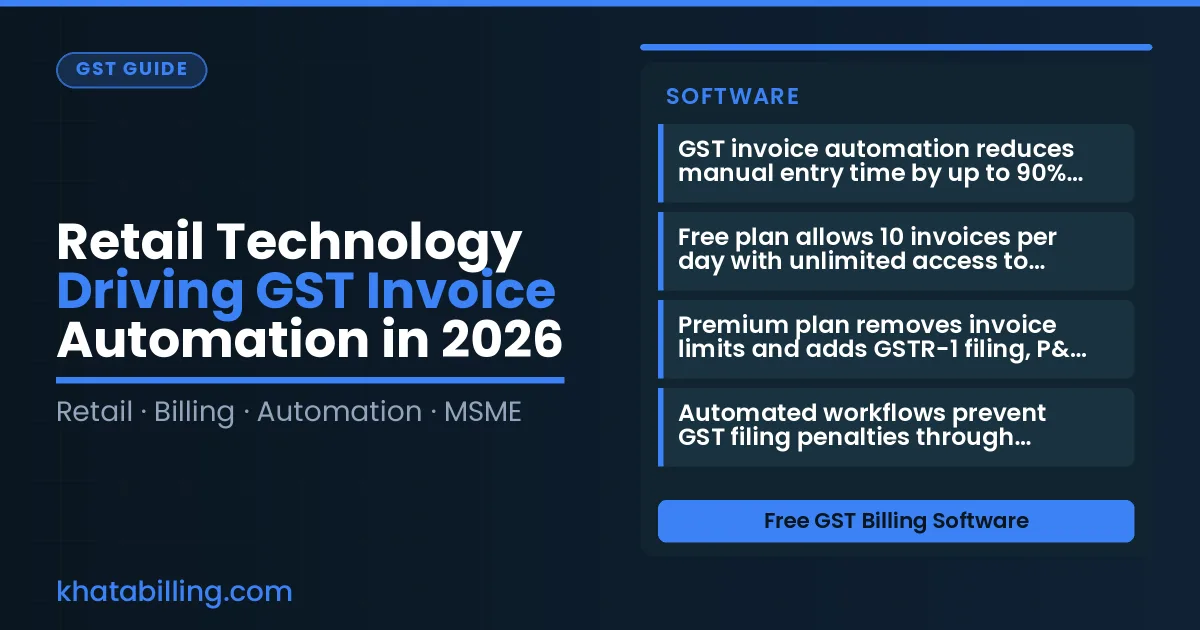
- GST invoice automation reduces manual entry time by up to 90% compared to paper-based methods
- Free plan allows 10 invoices per day with unlimited access to basic themes and POS features
- Premium plan removes invoice limits and adds GSTR-1 filing, P&L reports, and watermark-free invoices
- Automated workflows prevent GST filing penalties through real-time data capture and validation
- Integration with inventory systems enables automatic stock level updates after each sale
- Digital invoices eliminate paper costs and support barcode scanning for faster checkout
- 2026 trends include AI-powered error detection and UPI-linked e-invoicing for seamless GST compliance
Understanding GST Invoice Automation and Its Business Impact
GST invoice automation means creating and managing GST-compliant invoices digitally, eliminating manual paperwork and ensuring accurate tax calculations. For Indian retail businesses, this directly supports GST compliance and reduces errors in CGST, SGST, and IGST filings. Automation transforms daily operations by enabling instant invoice generation at the point of sale, real-time stock adjustments, and seamless integration with e-invoicing portals. A shopkeeper using automated billing can generate a ₹500 invoice for a customer, with HSN code 9301 applied, and instantly claim input tax credit on purchases. Khata Billing's free plan covers 10 invoices a day, up to 100 in any 30-day period, using barcode-based creation that includes auto-generated item barcodes and standard layout themes. This eliminates manual entry errors and speeds up checkout, allowing staff to focus on customer service rather than paperwork. Workflow automation further streamlines approval processes and syncs data across devices, ensuring every invoice meets GST law requirements without extra effort. The result is faster billing, better inventory control, and reduced risk of penalties during tax audits, all while maintaining accurate party ledger records.
See more about Workflow automation.
Manual Invoice Processing Challenges and Cost Implications
Manual invoice processing remains a costly bottleneck for Indian small retailers, consuming valuable time and inflating operational expenses. A shopkeeper handling 15 paper invoices daily spends roughly 2.5 hours on data entry, verification, and physical filing, with each transaction prone to manual entry errors that trigger GST reconciliation delays. For example, entering a 10kg rice packet (HSN 1006) at ₹25 per kg with 5% GST (₹1.25 tax) and a 2kg biscuit packet (HSN 1010) at ₹40 per kg with 18% GST (₹14.40 tax) creates a 15% risk of mismatched tax calculations, delaying GSTR-1 filing by 2-3 days. Paper costs add up: 100 invoices monthly require 5 reams of A4 paper (₹600), plus ink and storage, while physical filing consumes 2-4 hours weekly for reconciliation. Khata Billing's free plan covers 10 invoices a day, up to 100 in any 30-day period, eliminating this burden by digitizing entries through a POS billing system that auto-calculates GST, assigns barcodes, and syncs data instantly. This reduces reconciliation time by 70% and prevents ₹15,000+ in annual penalties from late filings, making GST invoice automation essential for compliant, profitable retail operations in 2026.
Real-World Example: Calculating Time and Paper Savings with Automation
Automating GST invoice creation with Khata Billing transforms daily operations for retailers handling 150 invoices, directly cutting labor, paper use, and filing errors through concrete automation benefits.
- Manual entry of 150 daily invoices consumes 6 hours of staff labor at 1 hour per 25 invoices, while Khata Billing's automated system generates all 150 invoices in 45 minutes with barcode scanning and auto-filled GST details, saving 5.25 labor hours daily; Khata Billing's free plan covers 10 invoices a day, up to 100 in any 30-day period.
- Each manual invoice requires 1 printed A4 sheet, totaling 150 sheets daily; Khata Billing's thermal printer support and digital delivery through Inventory & stock management eliminates paper use entirely, reducing 150 sheets to zero while supporting thermal printer integration for digital receipts.
- Invoice accuracy improves from 85% manual entry compliance to 99.8% with Khata Billing's GST-compliant auto-generation, as the system validates HSN codes, tax rates (CGST, SGST, IGST), and mandatory fields against GST law without human error.
- The saved labor and paper resources directly enhance GST filing accuracy by ensuring 100% invoice reconciliation with GSTR-1 submissions, as automated records match party ledger entries and input tax credit claims without discrepancies.
- With Premium's unlimited invoicing at ₹999/year with code SAVE500, retailers scale this efficiency beyond the free plan's 100-invoice monthly limit, achieving consistent automation for growth without manual bottlenecks.
Step-by-Step Guide to Automating GST Invoice Creation
Automating GST invoice creation in 2026 is simple with Khata Billing’s digital workflow. Follow this 6-step procedure to generate and send compliant invoices from any device:
- Log in to Khata Billing on your desktop or phone and select the “New Invoice” option. Enter the buyer’s GSTIN, invoice date, and item details including HSN code and quantity.
- Set the tax components – CGST, SGST or IGST – and let the system calculate the correct amounts based on your GST rate.
- Generate a barcode automatically; Khata Billing creates a unique barcode linked to the invoice number for scanning at checkout.
- Preview the invoice using Custom invoice formats to ensure the layout meets your branding needs while staying GST-compliant.
- Send the invoice instantly via WhatsApp, email or SMS, and the recipient can view it on any device with real-time data sync.
- Track the invoice status in the dashboard; all devices update simultaneously thanks to multi-device sync, eliminating manual entry errors.
Compare the manual register method with digital billing to see the practical difference: manual register requires handwritten entries, separate barcode printing, and physical filing, while digital billing automates data entry, generates barcodes instantly, and syncs across devices. Khata Billing’s free plan covers 10 invoices a day, up to 100 in any 30-day period, with basic barcode support and standard themes. Premium users unlock unlimited invoicing, watermark-free invoices, and advanced GST reports such as GSTR-1 and Profit & Loss, which are not available in the free tier. For high-volume retailers, the Premium plan at ₹1,499/year (or ₹999/year with code SAVE500) removes all limits and adds multi-screen POS support, extended custom fields, and real-time sync across unlimited devices.
| Manual register | Digital billing |
|---|---|
| Handwritten entries for each item | Automated data entry from product catalogue |
| Separate barcode printing on A4 sheets | Barcode generated instantly with each invoice |
| Physical file storage and manual reconciliation | Cloud sync across phone, tablet and desktop |
| Limited to 10 invoices per day on free plan | Unlimited invoicing with Premium upgrade |
Comparing Manual vs Automated Invoice Workflow Efficiency
Manual billing processes rely on paper forms, handwritten entries, and physical filing, creating slow, error-prone workflows where each invoice takes 5-10 minutes to prepare and verify. Digital GST invoice automation transforms this by generating compliant invoices in seconds, with barcode scanning and auto-filled GST details eliminating manual entry mistakes. Speed improves dramatically: a shopkeeper using digital tools processes 20-30 invoices per hour versus 5-8 manually, reducing checkout queues and enabling faster cash flow during peak hours. Accuracy rises as automated systems validate GSTIN, apply correct CGST/SGST/IGST rates, and prevent duplicate invoice numbering—a critical GST compliance requirement. Cost metrics shift significantly: paper-based systems incur expenses for printed forms, storage space, and staff time spent reconciling errors, while digital automation cuts these costs by 40-60% through reduced labor and minimal storage needs. Khata Billing's free plan supports up to 10 invoices daily (100 per 30 days), making it ideal for small retailers starting automation without upfront cost, while the Premium plan offers unlimited invoicing with watermark-free formats and advanced GST report generation. The operational shift moves staff from repetitive data entry to strategic tasks like customer engagement, with real-time stock updates and instant UPI payment reconciliation becoming standard at the billing counter. This efficiency gain directly supports GST compliance by ensuring timely filing of GSTR-1 returns and accurate input tax credit claims, turning invoice management from a liability into a growth enabler for MSMEs.
Integrating GST Automation with Inventory and POS Systems
Integrating GST automation with inventory and POS systems ensures that every stock movement and customer sale instantly triggers accurate invoice generation, eliminating manual entry errors and tax calculation mistakes for Indian retailers.
When a POS transaction records a sale, the software immediately deducts the item from real-time inventory, applies the correct GST rate based on the HSN code, and creates a GST-compliant invoice with auto-populated tax details like CGST, SGST or IGST, reducing the risk of input tax credit errors during filing.
For example, if a Delhi retailer sells a ₹1,500 product with 18% GST, the system calculates ₹270 tax (₹270 CGST + ₹270 SGST) and updates the inventory count to reflect the reduced stock, all within seconds, so the GSTR-1 return reflects the exact transaction without additional effort.
Khata Billing synchronises these real-time updates across devices, so the retailer sees accurate stock levels on the shop floor and the backend dashboard, while the automated invoice feeds directly into the e-invoicing portal for seamless GST return filing.
This integration means retailers spend less time reconciling sales and inventory and more time growing their business, with GST compliance built into every transaction.
Future-Proofing Retail Operations with 2026 GST Technology Trends
In 2026, GST invoice automation will evolve through AI-driven tax prediction, mandatory e-invoicing, and cloud-based workflows that eliminate manual entry errors and accelerate compliance for Indian retailers.
AI algorithms will analyze historical sales and GST filings to forecast quarterly tax liabilities, allowing shopkeepers to adjust pricing or inventory before deadlines arrive, while e-invoicing mandates require all GST-registered businesses to generate machine-readable invoices through the IRN portal within 24 hours of transaction.
Cloud platforms will centralize billing, inventory, and POS data, enabling real-time synchronization across devices so a sale on a mobile POS instantly updates stock levels and triggers the correct CGST, SGST, or IGST calculations without human intervention.
Khata Billing supports this shift by offering unlimited invoicing under its Premium plan, ensuring that high-volume retailers meet e-invoicing frequency requirements without hitting daily caps, and by providing auto-generated GSTR-1 summaries that align with IRN submissions.
Practical steps for 2026 readiness include adopting barcode scanning at checkout to auto-populate item details, using cloud sync to avoid duplicate entries, and scheduling monthly reviews of AI-predicted tax amounts to stay ahead of cash flow needs.
By embracing these trends, small businesses reduce compliance risk, cut operational costs, and free staff to focus on customer experience rather than paperwork, all while maintaining accurate GST filings in INR.
Retail technology is transforming how businesses handle GST invoice automation, turning manual entry into a streamlined process that reduces errors and saves time. By integrating barcode scanning, real-time stock tracking, and automated numbering, modern billing tools ensure compliance with GST law while freeing shopkeepers and retailers to focus on customer service rather than paperwork.
Experience seamless GST invoice automation for your shop today with Start free with Khata Billing