- Understanding 2026 GST Invoice Numbering Rules for Retailers
- Manual Invoice Creation Process vs GST-Compliant Digital Workflow
- Step-by-Step Guide to Setting Up GST-Ready Inventory Tracking for 2026
- Comparative Analysis: Paper-Based vs Digital GST Compliance Methods
- Integrating POS Data with GST Reporting for Seamless 2026 Filing
- Common 2026 GST Mistakes Retailers Make and How to Avoid Them
- Future-Proofing Your Retail Business Against 2026 GST Changes
- Frequently Asked Questions
Khata Billing helps retailers navigate 2026 GST Updates by enabling GST-compliant digital invoicing and inventory management that meet new numbering rules and filing requirements.
Under the 2026 GST regime, retailers must issue invoices with sequential numbering and accurate item details to avoid penalties, and Khata Billing's digital workflow automates these tasks while supporting unlimited invoicing in its Premium plan at ₹1,499/year.
✅ Key Takeaways
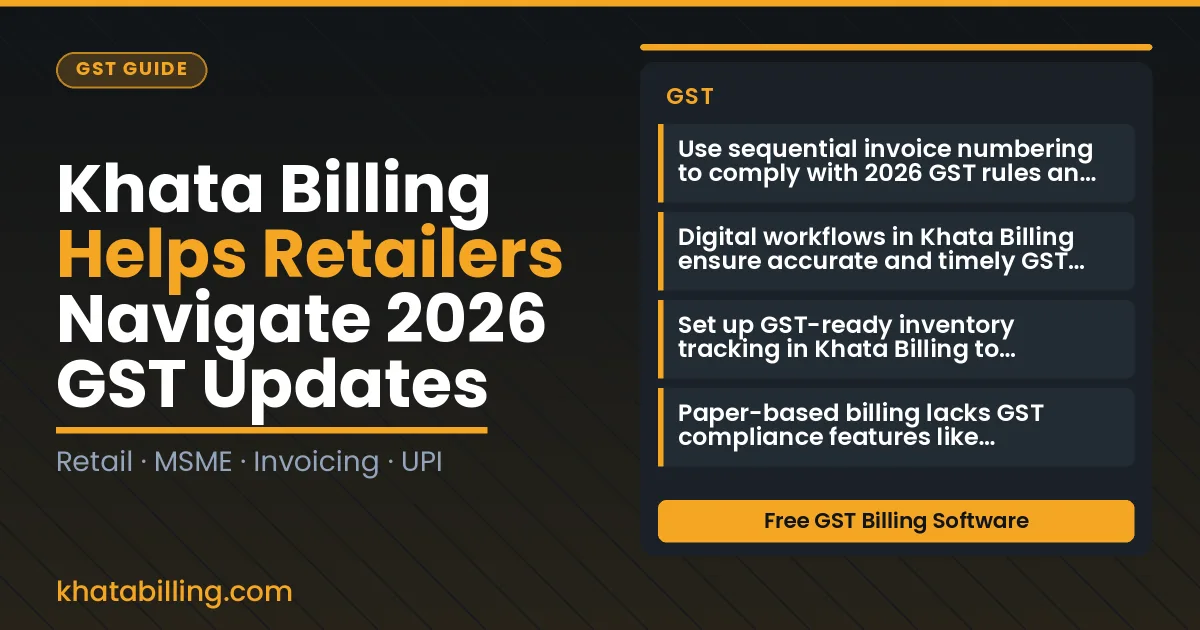
- Use sequential invoice numbering to comply with 2026 GST rules and avoid penalties
- Digital workflows in Khata Billing ensure accurate and timely GST filing for retailers
- Set up GST-ready inventory tracking in Khata Billing to maintain accurate stock records for 2026 compliance
- Paper-based billing lacks GST compliance features like sequential numbering and automated reports
- Integrate POS data with Khata Billing's GST reports for seamless 2026 filing
- Avoid common mistakes like missing invoice details and incorrect stock adjustments by using Khata Billing
- Upgrade to Khata Billing Premium for unlimited invoicing and advanced GST reporting features
Understanding 2026 GST Invoice Numbering Rules for Retailers
Understanding the GST Updates for 2026 means retailers must follow a mandatory invoice numbering sequence that starts at 1 and increments by 1 for each invoice, with no gaps or repeats allowed. The sequence must be continuous across devices, ensuring that the first invoice of the day is the next number after the last one issued yesterday. Required fields on every invoice include GSTIN, legal name, address, HSN code for each item, taxable value, CGST, SGST or IGST, and the total amount. Daily and monthly limits apply: the free plan covers 10 invoices a day and 100 in any 30-day period, while Premium offers unlimited invoicing. Manual errors in numbering or field entry can cause filing rejections, leading to delays in input tax credit claims and penalties. To stay compliant without manual errors, retailers can enable automatic invoice numbering in Khata Billing, which syncs across desktop and mobile devices and enforces the daily limit of 10 invoices, preventing accidental overuse. The system also validates each field, ensuring that GSTIN and HSN codes match the latest GST portal requirements, and that tax calculations reflect the correct CGST/SGST/IGST split. With Inventory & stock management integrated, stock adjustments automatically update invoice details, reducing transcription mistakes. By using these features, retailers maintain a clean audit trail, meet GST compliance, and avoid the common pitfalls of manual billing, all while keeping their focus on daily sales and customer service.
Manual Invoice Creation Process vs GST-Compliant Digital Workflow
Manual invoice creation in 2026 requires shopkeepers to calculate subtotals, apply GST rates, and verify invoice numbering, which introduces calculation errors and delays. A typical manual process for a small retailer includes writing down item details, manually summing values, and formatting the invoice to match GST rules. Automated digital workflows eliminate these steps by generating GST-compliant invoices instantly through software like Khata Billing. For example, a retailer selling 5 units of "Milk" at ₹30 each (18% GST) and 2 units of "Bread" at ₹25 each (5% GST) would calculate a subtotal of ₹210 for Milk (5×30) and ₹50 for Bread (2×25), then apply 18% GST (₹37.80) and 5% GST (₹2.50), resulting in a total of ₹249.80. This arithmetic must be repeated for every invoice, increasing error risk. In contrast, Khata Billing’s digital system auto-calculates GST, applies correct HSN codes, and formats the invoice with required fields, ensuring compliance without manual math. The Custom invoice formats feature lets retailers preview and adjust layouts while maintaining GST standards. Automated systems also sync data in real time, reducing paperwork and ensuring accurate stock and party ledger updates.
Step-by-Step Guide to Setting Up GST-Ready Inventory Tracking for 2026
- Log in to Khata Billing’s dashboard, navigate to the Inventory module, and enable real-time stock tracking by linking your barcode scanner to the system; each time an item is sold or restocked, the quantity automatically updates across desktop and mobile devices, ensuring accurate records for GST-compliant input tax credit claims.
- Set up barcode integration by importing your product list with unique barcodes, then use the built‑in scanner feature to scan items at the point of sale; the system captures the HSN code, quantity, and price instantly, eliminating manual entry errors and supporting the 2026 requirement that every sale be traceable to a GST invoice.
- Configure automatic inventory adjustments by defining reorder thresholds in the Business reports section; when stock falls below the set level, Khata Billing triggers a low‑stock alert and can generate a purchase order draft, keeping inventory balanced for timely ITC eligibility.
- Enable automated inventory reports by selecting the “Stock Valuation” report under the Premium reporting suite; this report updates in real time and includes GST‑ready data such as CGST, SGST, and IGST breakdowns, allowing retailers to verify input tax credit eligibility without manual calculations.
- Link your bank and cash accounts in the Accounting settings so that every inventory adjustment is reflected in the ledger; this ensures that the cost of goods sold matches the GST invoice values, a prerequisite for claiming input tax credit under the 2026 GST updates.
- Review the generated inventory summary weekly, reconcile it with your physical stock, and use the export feature to download the data in Excel for further analysis; this practice maintains compliance and supports smooth GST filing for MSMEs.
Comparative Analysis: Paper-Based vs Digital GST Compliance Methods
When GST Updates arrive, retailers face a critical choice: continue with paper-based registration or adopt digital billing systems. Manual register workflows rely on handwritten invoices, physical ledgers, and manual tallying, while digital billing integrates directly with GST portals through automated invoice generation and electronic record-keeping. This transition dramatically improves compliance with real-world operational demands.
Consider a typical Delhi-based general store processing 50 daily invoices. In the manual method, clerks spend 15 minutes per invoice verifying GSTIN, calculating CGST/SGST, and matching HSN codes. This adds up to 12.5 hours daily just for invoice entry, with frequent transcription errors from handwriting or arithmetic mistakes. Such inefficiencies cause delayed filings, mismatched input tax credit claims, and audit failures where 30% of paper-based returns face queries due to calculation errors. In contrast, digital billing streamlines the same process in under 2 minutes per invoice through auto-populated GST fields, barcode scanning of item labels, and instant tax computation. Retailers using digital methods report 70% faster reconciliation and near-zero calculation errors, directly addressing GST Updates' strict accuracy requirements. The shift eliminates manual data re-entry between sales registers and accounting books, reducing audit preparation time from days to hours while ensuring every invoice meets e-invoicing standards. For small businesses, this efficiency translates to significant INR savings on labor and avoids penalties from filing inaccuracies. Expense tracking becomes simpler when digital records sync automatically with GST filings, creating a unified audit trail that satisfies tax authorities without additional paperwork.
Integrating POS Data with GST Reporting for Seamless 2026 Filing
Linking your POS data directly to Khata Billing's GST software automates GSTR-1 preparation by importing every scanned invoice, reducing manual entry errors and ensuring filing aligns with the 2026 GST Updates.
When a retailer scans a customer's items at the billing counter, the POS records the transaction instantly. Khata Billing captures the GSTIN, item details, and tax breakdown, then compiles these into the GSTR-1 summary without additional steps.
This integration eliminates daily reconciliation effort: sales data from the POS matches the GSTR-1 filings automatically, so you avoid mismatches between recorded revenue and tax liability. Timely filing becomes easier as the software flags pending entries before the monthly deadline.
For example, if a shop sells ₹500 worth of goods with 18% GST, Khata Billing records ₹82 (18% of 500) as CGST and SGST, and posts the transaction to the GSTR-1 summary. The system updates the party ledger and stock levels simultaneously, ensuring accurate input tax credit claims under the updated 2026 rules.
By connecting POS transaction data with GST reporting, retailers maintain real-time visibility of their tax obligations, meet updated 2026 compliance deadlines, and focus on customer service rather than paperwork, all while using Khata Billing's automated workflows.
Common 2026 GST Mistakes Retailers Make and How to Avoid Them
Retailers frequently err with incorrect HSN code usage, leading to GST classification disputes. For example, a shopkeeper may assign a 12% rate to a product that belongs to 18%, causing tax calculation errors. Prevention involves using Khata Billing's barcode scanner, which auto-selects the correct HSN based on item details. Mismatched invoice dates are another common issue; an invoice dated 31 March for a transaction on 1 April creates reconciliation problems with GSTN. Retailers should ensure the billing date aligns with the actual date of supply, which Khata Billing enforces by default when generating e-invoices. Improper tax classification, such as treating inter-state supplies as intra-state, results in wrong CGST/SGST calculations and potential penalties. Manual entry often causes these errors, but Khata Billing's real-time GST validation flags mismatches before submission. The free plan covers 10 invoices a day, up to 100 in any 30-day period, so retailers must batch corrections carefully. Premium users benefit from unlimited invoicing, eliminating date-related conflicts. Additionally, GSTR-1 and Profit & Loss reports are Premium features, so retailers using the free tier should verify their data monthly through basic sales summaries. By adopting Khata Billing's auto-HSN assignment, date-stamping controls, and clear invoice numbering, retailers prevent costly compliance mistakes while staying within free plan limits.
Future-Proofing Your Retail Business Against 2026 GST Changes
To stay ahead of the 2026 GST Updates, retailers must adopt proactive measures that blend staff training, timely system updates, and digital tools. Begin by scheduling monthly workshops where cashiers and accountants learn new GST formats, such as updated HSN codes and revised GSTR-1 filing timelines, ensuring everyone understands how invoice numbering and barcode scanning requirements evolve. Use Khata Billing’s real-time data sync to automatically push these changes to staff mobile devices, so every billing counter reflects the latest tax rules without manual intervention. Set calendar reminders to check for Khata Billing system updates quarterly; the platform delivers GST-compliant patches that adjust invoice themes, tax calculations, and e-invoicing protocols, eliminating the risk of outdated software during critical filing periods. Integrate Khata Billing’s barcode scanning feature with inventory management to maintain accurate stock valuation as tax rates shift, preventing manual entry errors that could trigger penalties. For dynamic pricing adjustments, leverage Khata Billing’s bulk import capability to update item details across hundreds of products in minutes, keeping GST calculations accurate. Finally, adopt Khata Billing’s digital business cards and custom URL storefront to showcase GST-compliant invoicing to customers, building trust while simplifying reconciliation. By treating GST Updates as an ongoing process rather than a one-time event, retailers protect their margins, avoid compliance delays, and maintain operational agility in a rapidly changing tax environment.
Khata Billing empowers retailers to adapt to the upcoming GST Updates with seamless invoicing and real-time stock tracking, ensuring every transaction meets compliance requirements without manual errors.
Embrace the full power of GST-ready tools today and simplify your billing workflow; Start free with Khata Billing.