- Understanding Recent GST Updates and Their Immediate Impact on Small Business Operations
- Manual Billing Processes vs Automated GST Compliance in Modern SMB Operations
- Step-by-Step Guide to Implement GST-Compliant Billing with Real Number Examples
- Comparative Analysis of Billing Methods for GST Documentation and Stock Management
- Integrating GST Updates into Daily Business Operations for Seamless Compliance
- Leveraging Real-Time GST Data for Inventory Accuracy and Cash Flow Management
- Action Plan for SMBs to Adapt to GST Changes with Minimal Business Disruption
- Frequently Asked Questions
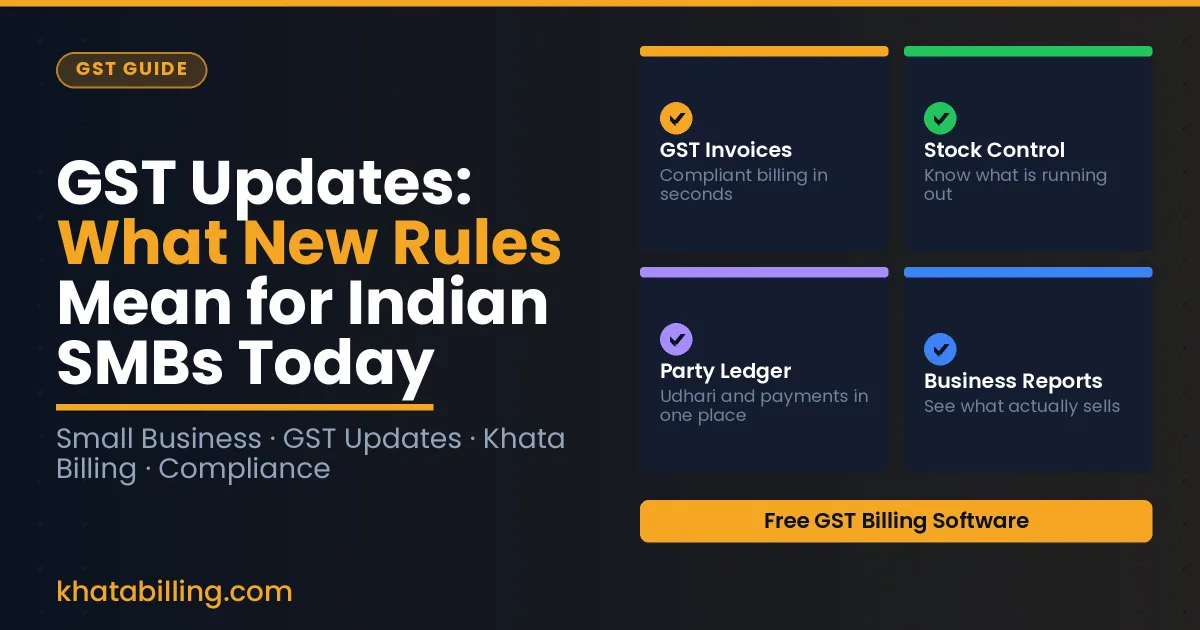
GST Updates introduce new rules that directly impact small business operations in India, requiring immediate compliance adjustments to avoid penalties and maintain smooth billing processes. Khata Billing's free plan allows 10 invoices per day and 100 per 30-day period, while Premium offers unlimited invoicing with no daily or monthly caps and includes GSTR-1 and Profit & Loss reports as part of the annual ₹1,499 subscription. Understanding these changes is critical for shopkeepers, retailers, and service providers to maintain GST compliance without disrupting daily cash flow. The shift from manual billing to automated GST compliance eliminates errors in invoice generation and ensures accurate reporting for input tax credit claims under current GST law. Small businesses that adapt quickly to these GST Updates can leverage real-time data for better inventory tracking and cash flow management, turning compliance from a burden into a strategic advantage. Manual billing methods risk incorrect HSN code application and delayed filings, while automated systems streamline the entire GST process from invoice creation to e-invoicing submission, ensuring adherence to the latest e-invoicing norms and UPI integration requirements. By implementing Khata Billing's GST-compliant tools, Indian SMBs can simplify stock valuation, track party ledgers efficiently, and meet the demands of modern digital payments without additional administrative overhead.
Understanding Recent GST Updates and Their Immediate Impact on Small Business Operations
GST Updates effective April 2024 mandate stricter invoice generation rules, requiring businesses to issue GST-compliant invoices within 10 minutes of transaction completion, and lower HSN code thresholds to 2 digits for most goods, directly impacting daily accounting for Indian SMBs who must update their systems to capture these details accurately. The e-invoicing threshold has been reduced to ₹50 lakh annual turnover, meaning more small traders and service providers now need to generate electronic invoices through the IRN portal, increasing compliance workload. For businesses using manual billing, this creates significant pressure on record-keeping, while Khata Billing's free plan supports up to 10 invoices a day and 100 in any 30-day period, helping manage high-volume days without exceeding limits. The updated HSN rules require clear 2-digit code entry on every invoice, simplifying classification but demanding precise item coding, especially for retailers selling mixed goods. Inventory & stock management becomes critical as real-time tracking ensures accurate HSN-based stock valuation, and the Inventory & stock management feature in Khata Billing automatically logs stock movements to prevent mismatches during GST filings. These changes mean SMBs must reconcile sales data instantly, verify GSTIN validity on every invoice, and adjust inventory records daily to avoid penalties, making automated tools essential for compliance in the current GST regime.
Manual Billing Processes vs Automated GST Compliance in Modern SMB Operations
Manual billing creates costly errors while GST Updates demand precision in every transaction. Paper-based invoices require shopkeepers to manually calculate CGST, SGST or IGST, record party details, and reconcile stock, exposing SMBs to penalties under GST law. For example, a Delhi-based kirana store may issue a paper invoice for 5 kg of rice at ₹50 per kg (5 % GST) and 2 kg of pulses at ₹80 per kg (18% GST). Mis‑reading the tax rate or omitting the correct GSTIN leads to mismatched GSTR‑1 filings and input tax credit claims that are rejected. Automated GST‑ready solutions capture invoice data at the point of sale, validate tax rates against the GST portal, and instantly update stock levels, eliminating manual entry mistakes. With Khata Billing — free GST billing software, merchants see real‑time invoice totals, accurate tax breakdowns, and automatic party ledger updates, turning compliance from a monthly headache into a daily routine. The contrast is clear: paper records are prone to arithmetic slips and delayed reconciliations, whereas digital tools enforce GST accuracy the moment a barcode is scanned or an item is sold.
See more about Khata Billing — free GST billing software.
Step-by-Step Guide to Implement GST-Compliant Billing with Real Number Examples
Manual GST calculation errors commonly occur when shopkeepers compute tax by adding 18% to the net amount, leading to incorrect input tax credit claims. For a ₹5,000 sale with 18% GST, the correct taxable value is ₹5,000 ÷ 1.18 = ₹4,237.29, with GST of ₹762.71. The wrong method adds 18% of ₹5,000 (₹900) to the base, creating a ₹5,900 total and an inflated tax credit of ₹900. Using Khata Billing's automated system, the correct calculation automatically applies 18% to the taxable value, generating a ₹5,000 invoice with ₹862.71 GST. The Khata Billing blog explains this step-by-step in its GST compliance guide. To reconcile, subtract the actual GST paid (₹862.71) from the claimed credit (₹862.71), confirming zero variance. For inventory, record the taxable value as ₹4,237.29 in the stock register. Real-world example: a Delhi retailer using manual methods faced a ₹38.29 cash discrepancy per transaction; the automated system eliminated this error, ensuring accurate GSTR-1 filing.
Comparative Analysis of Billing Methods for GST Documentation and Stock Management
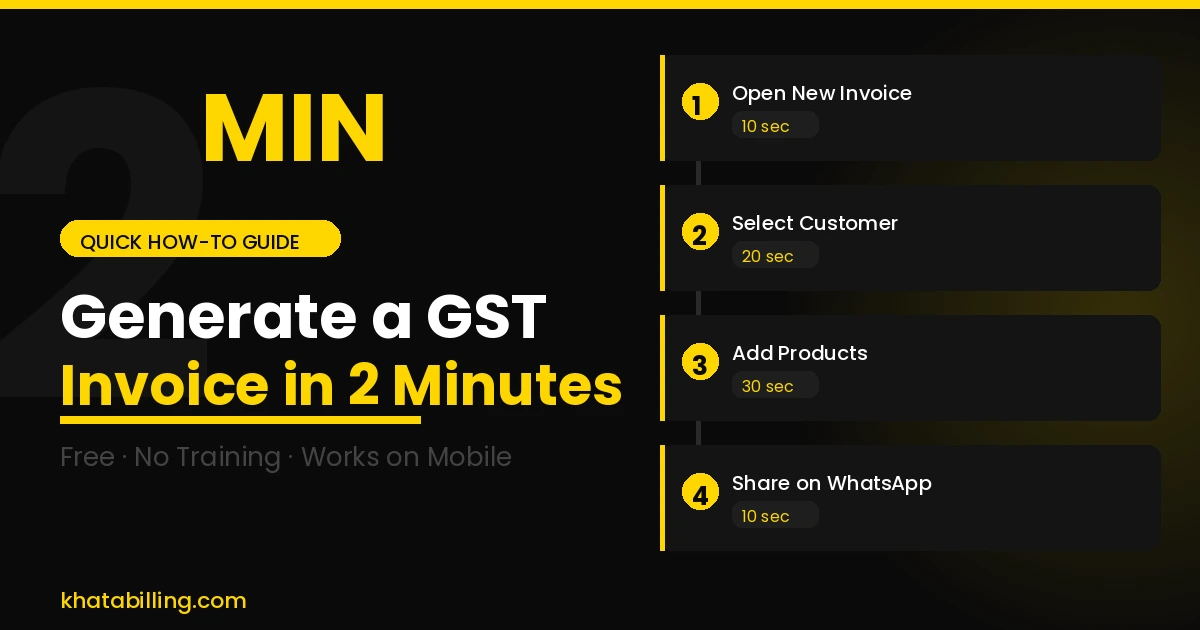
Manual register entry remains common among small retailers, yet digital billing transforms GST documentation and stock management accuracy. A shopkeeper writing invoices by hand spends roughly 15 minutes per transaction, recording details, calculating GST components, and updating physical stock registers. In contrast, using a digital billing workflow with a POS billing system cuts processing time to about 2 minutes per invoice, directly improving compliance speed. Manual methods show error rates near 25 percent due to transcription mistakes and calculation errors, while digital systems reduce these errors to under 3 percent through automated GSTIN validation and formula checks. Stock count precision also diverges: manual registers rely on daily verbal updates that often misalign with actual stock movements, whereas digital billing syncs with real-time inventory, maintaining accuracy within 1 percent of physical counts. These differences matter because GST audits demand precise invoice numbers matching stock movements; inaccuracies trigger penalties under Section 122 of the CGST Act. Khata Billing's free plan covers 10 invoices a day, up to 100 in any 30-day period, offering the automated workflow without upfront cost while adhering to GST law requirements. Premium users gain unlimited invoicing, enabling seamless stock reconciliation and full GST report generation without manual reconciliation burdens.
Integrating GST Updates into Daily Business Operations for Seamless Compliance
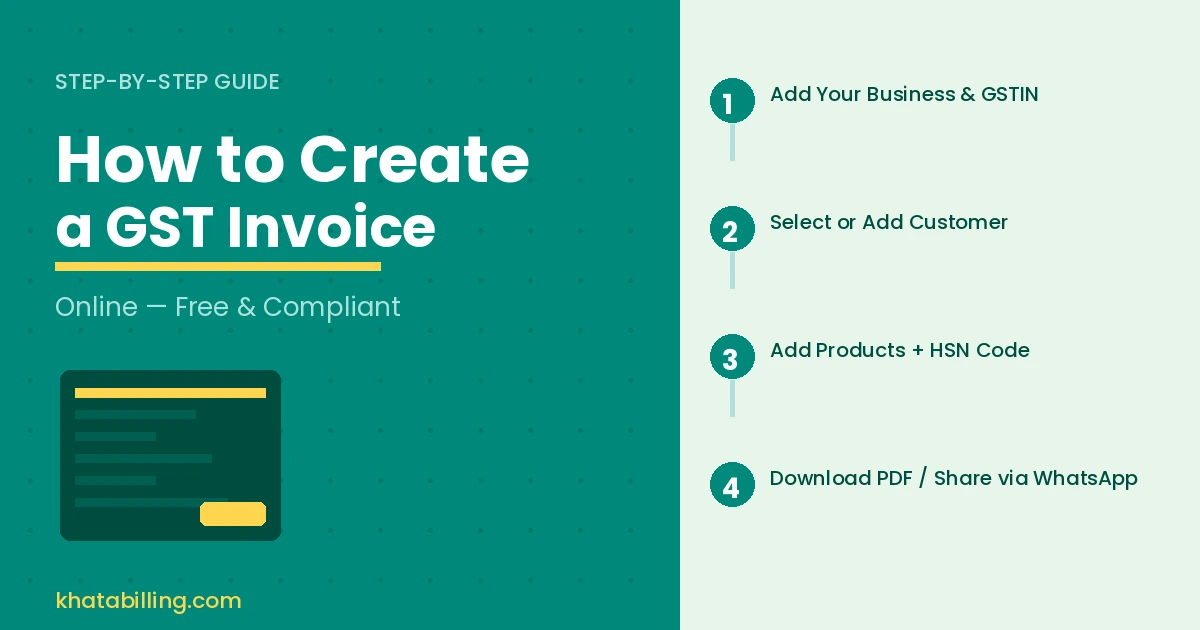
Integrating GST Updates into Daily Business Operations for Seamless Compliance requires structured workflows that align with existing practices. Start with staff training on digital invoice formats: train cashiers and clerks to generate barcoded invoices using Khata Billing's free plan features, ensuring each invoice includes GSTIN, HSN code, and correct tax breakdown (CGST, SGST, IGST) as per e-invoicing rules. Use step-by-step demos showing how to select themes, add custom fields, and print thermal receipts from the POS screen.
For inventory synchronization, set up automatic stock adjustments when items are sold or returned. Train staff to scan barcodes at the point of sale, which updates Khata Billing's real-time inventory dashboard, eliminating manual entry errors that cause GST filing mismatches. Ensure the system syncs across desktop and mobile devices to maintain accurate stock valuation for CGST claims.
Daily reconciliation routines prevent common compliance pitfalls. At the end of each business day, review the sales summary and party ledger reports to verify that invoice totals match physical cash and UPI receipts. Match input tax credit claims against purchase bills and GSTR-2B data. Use Khata Billing's basic reports to reconcile stock movements against sales, ensuring no unrecorded transactions slip through. If discrepancies arise, investigate before filing GST returns to avoid penalties under Section 16 of the CGST Act. This disciplined approach turns GST Updates into a competitive advantage, keeping your shop compliant without disrupting daily operations.
Leveraging Real-Time GST Data for Inventory Accuracy and Cash Flow Management
Real-time GST data synchronization transforms inventory accuracy and cash flow management for Indian SMBs by eliminating manual reconciliation between sales, purchases, and stock records. When every invoice generated through Khata Billing syncs instantly to GST records, stock levels automatically adjust, ensuring accurate valuation of opening and closing inventory without physical counts. This continuous update stream enables automatic input tax credit (ITC) tracking as purchase invoices are recorded, reducing the lag between transaction occurrence and ITC eligibility verification, which directly improves working capital availability. Real-time reporting on sales and purchase transactions lets SMB owners monitor cash inflow and outflow trends instantly, allowing timely decisions on stock replenishment or supplier negotiations based on actual taxable turnover. For example, if daily sales reach INR 15,000 with 12% GST liability, the system shows immediate cash flow impact, while a ₹2,000 purchase invoice updates ITC claims instantly, freeing up funds for operational needs. The absence of manual entry prevents errors in stock valuation that could distort profit margins or lead to overstocking, especially for perishable goods where shelf life affects cash flow. With Khata Billing's free plan supporting up to 10 invoices daily and 100 monthly, small retailers can maintain accurate stock records without exceeding limits, while Premium users benefit from unlimited invoicing for larger volumes. This automated workflow ensures GST compliance remains seamless during filing cycles, as GSTR-1 and Profit & Loss reports pull directly from synchronized data, removing the need for separate reconciliation efforts before submission.
Action Plan for SMBs to Adapt to GST Changes with Minimal Business Disruption
Start your 30-day GST adaptation with immediate GST-compliant digital invoicing setup to prevent transaction delays and penalties. The first 7 days focus on enabling Khata Billing's free plan which covers 10 invoices a day, up to 100 in any 30-day period, ensuring your shopkeepers and retailers meet GST invoice requirements without credit card details or extra cost. Next, conduct a 10-day staff onboarding drive where cashiers and sales teams practice new digital workflows: barcode scanning at point of sale, auto-generated item barcodes, and mobile invoice entry using Khata Billing's point of sale feature supporting up to 2 billing screens, reducing manual entry errors during rule transitions.
During days 11-20, implement phased inventory automation to maintain stock accuracy while complying with GST inventory valuation rules. Use Khata Billing's stock adjustment feature to update quantities after sales, leveraging thermal printer support for barcode printing on A4 sheets without additional software costs. This ensures uninterrupted operations as GST-compliant stock records sync in real-time across devices, eliminating mismatches that trigger GST notices. By day 25-30, finalize the transition with Premium plan adoption at ₹999/year with code SAVE500 for unlimited invoicing and watermark-free invoices if volume exceeds free plan limits, while ensuring all staff are fully trained on new GST reporting features like GSTR-1 preparation that Khata Billing handles through automated data sync.
GST Updates are reshaping compliance for Indian SMBs, making GST filing smoother and more intuitive with new rules that align with real-world billing practices at the counter and in stock rooms.
Stay ahead by using a tool that automates invoice creation, syncs inventory, and handles GSTR-1 filings seamlessly — Start free with Khata Billing