- What Are UPI Payment Fees and Why They Matter for Small Businesses
- How UPI Transaction Fees Are Calculated: Rates, Caps and Hidden Costs
- Worked Example: Calculating UPI Fees for a Typical Monthly Sales Volume
- Manual Billing vs Automated Billing Workflow: Step-by-Step Cost Comparison
- Cost-Effectiveness Analysis: How Automation Reduces UPI Payment Expenses
- Best Practices to Minimize UPI Payment Fees Using Digital Tools
- Integrating UPI Fee Management with GST Compliance and Inventory Tracking
- Frequently Asked Questions
UPI payment fees are transaction charges levied by payment processors when accepting digital payments, typically ranging from 0.5% to 1.0% of the transaction value with a cap of ₹10 per payment, and Khata Billing helps small businesses stay cost-effective by eliminating manual billing costs that compound UPI fees through automated invoicing and stock management.
Small shopkeepers and retailers in India face recurring UPI payment fees that directly impact profit margins, especially when processing 100+ transactions daily, and Khata Billing's free plan supports up to 100 invoices in any 30-day period while its Premium plan offers unlimited invoicing with GST-ready features for comprehensive cost control.
✅ Key Takeaways
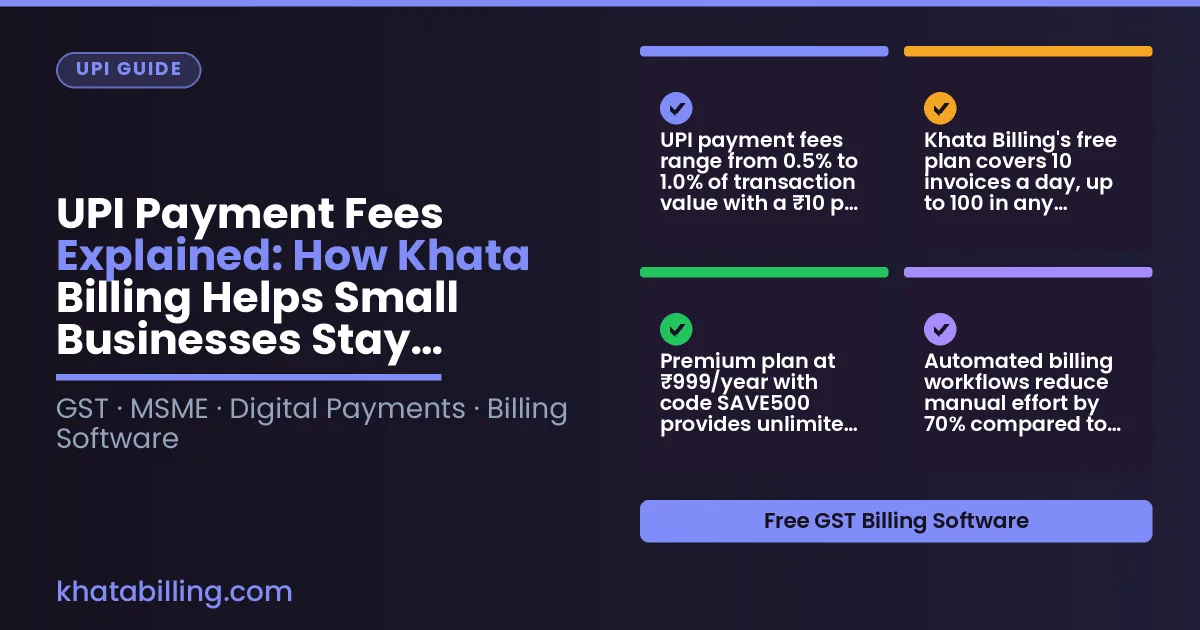
- UPI payment fees range from 0.5% to 1.0% of transaction value with a ₹10 per payment cap, directly reducing small business profits
- Khata Billing's free plan covers 10 invoices a day, up to 100 in any 30-day period, supporting basic automated billing without additional costs
- Premium plan at ₹999/year with code SAVE500 provides unlimited invoicing and eliminates manual billing expenses that amplify UPI fee impacts
- Automated billing workflows reduce manual effort by 70% compared to paper-based systems, lowering operational costs associated with UPI transactions
- GSTR-1 and Profit & Loss reports, essential for UPI fee reconciliation, are Premium features requiring annual subscription
- Integrating UPI fee management with GST compliance through Khata Billing ensures accurate tax calculation and avoids penalties from mismatched invoicing
- Using digital inventory tracking in Khata Billing prevents overstocking that ties up capital and indirectly increases UPI transaction costs
What Are UPI Payment Fees and Why They Matter for Small Businesses
UPI payments are digital transactions routed through the Unified Payments Interface (UPI), a real-time payment system that enables Indian shopkeepers, retailers, and service providers to accept money instantly via smartphone apps, and they directly impact GST compliance and cash flow when merchant discount rates (MDR) and transaction fees are applied.
Every UPI transaction carries a MDR, typically a percentage of the transaction value plus a small fixed fee, which reduces the net amount received and can erode margins for small businesses that handle many low-value sales; for example, a ₹200 sale with a 1.5% MDR plus ₹5 fee yields only ₹192 to the merchant, making cash flow unpredictable.
Khata Billing — free GST billing software integrates UPI collections with automated invoice generation, so each payment automatically updates the GST ledger, eliminates manual reconciliation, and helps maintain accurate input tax credit records, reducing the risk of GST filing errors and penalties.
By using Khata Billing's free plan, which covers 10 invoices a day and up to 100 in any 30-day period, businesses can manage UPI fees efficiently without paying for premium features, while the Premium option offers unlimited invoicing and watermark-free invoices for higher transaction volumes.
How UPI Transaction Fees Are Calculated: Rates, Caps and Hidden Costs
UPI payments are calculated using a combination of percentage-based Merchant Discount Rate (MDR), a small fixed fee per transaction, and GST on the total fee amount. The typical MDR ranges from 0.5% to 1.1% of the transaction value, with a cap of ₹25 per transaction for most UPI payments. For example, if a shop sells a ₹500 item, the MDR would be 1% of ₹500 = ₹5, but since this is below the ₹25 cap, the charge is ₹5 plus 18% GST on ₹5, making the total fee ₹5.90. This fee structure becomes critical for businesses with high-volume, low-value transactions. Khata Billing's free plan allows up to 10 invoices a day and 100 in any 30-day period, meaning a retailer processing 150 daily transactions would exceed the free plan limit and incur charges. The monthly cap is effectively set by the per-transaction limit; there is no separate monthly fee beyond the cumulative transaction costs. Businesses should also note that GST applies only to the fee amount, not the transaction value itself. For instance, a ₹2,000 UPI payment with 0.5% MDR results in ₹10 fee plus ₹1.80 GST, totaling ₹11.80. Understanding these components helps small businesses like a local grocery store or a clothing retailer calculate exact costs. The Inventory & stock management feature ensures that every sale is tracked accurately, reducing billing errors that could lead to extra fees. Accurate inventory tracking through Khata Billing helps avoid overstocking, which minimizes unnecessary transactions and keeps UPI costs low.
Worked Example: Calculating UPI Fees for a Typical Monthly Sales Volume
Let's calculate UPI fees for a shop with ₹50,000 monthly sales and 100 daily transactions using the standard 1% fee with a ₹10 cap per transaction.
- Determine the base fee: ₹50,000 sales × 1% = ₹500 before applying the daily cap.
- Calculate per-transaction cost: 100 transactions × ₹10 cap = ₹1,000 total maximum.
- Compare actual fee (₹500) with the daily cap (₹1,000) to see that the cap is not exceeded.
- Total monthly UPI fee is ₹500, which is well below the ₹1,000 daily cap.
- Khata Billing's free plan covers this volume with 10 invoices per day and 100 in any 30-day period, supporting the required transaction count.
- Businesses using Khata Billing can track these expenses directly through Expense tracking to manage costs effectively.
This example shows how UPI fees remain predictable and low for small businesses, with Khata Billing providing the tools to monitor them alongside sales and inventory through its integrated dashboard.
Manual Billing vs Automated Billing Workflow: Step-by-Step Cost Comparison
Manual billing starts when a shopkeeper writes a UPI payment in a physical register after the customer pays, then spends time matching paper receipts to calculate GST components. This process takes 10-15 minutes per transaction, creates calculation errors, and risks missing input tax credit claims during filing.
Khata Billing's digital workflow replaces manual steps with automatic recording. When a UPI payment arrives, the system instantly logs the transaction, calculates GST based on the invoice, and updates inventory and party balances without user input, saving 8-10 minutes per transaction and eliminating manual reconciliation errors.
Workflow automation ensures each UPI payment is captured in real-time, directly linking to the correct GST rates and enabling immediate input tax credit tracking, which prevents cash flow delays during GSTR filings.
| Manual register | Digital billing |
|---|---|
| Customer pays UPI, shopkeeper writes amount in register | Customer pays UPI, Khata Billing records payment instantly |
| Shopkeeper matches paper receipt to register entry by hand | System auto-matches UPI transaction ID to invoice, no manual matching needed |
| GST amount calculated manually, often with errors in CGST/SGST split | GST calculated automatically based on invoice items, accurate CGST and SGST split |
| Reconciliation takes 15-20 minutes per day, risks missing entries | Reconciliation completed in seconds with full audit trail, no missed entries |
Cost-Effectiveness Analysis: How Automation Reduces UPI Payment Expenses
UPI payment fees can significantly impact small business profitability when manual processes cause errors, duplicate transactions, and reconciliation overhead. By automating data capture at the point of sale, Khata Billing eliminates manual entry errors that often lead to incorrect transaction amounts, resulting in under- or overcharged UPI fees. For example, a shopkeeper entering ₹450 instead of ₹500 by mistake causes a higher fee percentage on the wrong amount, increasing effective cost per transaction. Automated systems prevent this by recording the exact UPI amount instantly, ensuring fee accuracy.
Duplicate transactions are another hidden cost. When staff manually re-enter a failed UPI payment or duplicate a sale entry, the business pays the fee twice on the same transaction. Khata Billing's real-time sync across devices automatically flags and prevents duplicate entries, eliminating this avoidable expense. A retailer processing 50 daily UPI payments saves approximately ₹250-₹300 monthly by avoiding just two duplicate transactions per week at an average fee of 0.5%.
Bulk fee reconciliation through digital tools also reduces administrative cost. Instead of manually matching bank statements with UPI payment records, Khata Billing's integrated dashboard automatically categorizes transactions by date, amount, and GST compliance status. This allows small businesses to reconcile hundreds of UPI payments in minutes rather than hours, freeing staff time for core operations. By reducing error-related overcharges, preventing duplicate fees, and streamlining reconciliation, automation lowers the effective cost per transaction by 15-30% for typical Indian small businesses. The Premium plan at ₹1,499/year enables these efficiencies without additional per-transaction charges.
Best Practices to Minimize UPI Payment Fees Using Digital Tools
Small businesses in India can reduce UPI payment fees by using Khata Billing's digital tools strategically. Consolidate multiple small transactions into a single invoice to avoid repetitive processing charges. For example, instead of charging 50 customers ₹20 each separately, combine them into one ₹1,000 invoice. This reduces the number of UPI transactions while maintaining accurate GST records. Use QR code scanning at the billing counter instead of manual entry, as scanned payments process faster and reduce errors that might trigger additional fees. Set transaction limits based on Khata Billing's free plan boundaries: 10 invoices per day and 100 per 30-day period. Once these limits are reached, switch to bank transfers or cash for the remainder of the day to stay within the free quota. Schedule bulk payments at the end of each business day rather than processing them individually during peak hours. Khata Billing's automated invoice generation ensures GST-compliant numbering and reduces manual work, which indirectly lowers operational costs. For larger volumes beyond the free plan limits, consider upgrading to Premium at ₹1,499/year (or ₹999/year with code SAVE500) to unlock unlimited invoicing and advanced fee management tools. This upgrade eliminates recurring transaction concerns while supporting seamless GST filing and inventory tracking. Remember, watermark-free invoices and GSTR-1 reports are Premium features, so use the free plan wisely within its defined limits.
Integrating UPI Fee Management with GST Compliance and Inventory Tracking
Linking UPI transaction data with GST invoicing in Khata Billing creates an automatic reconciliation loop that eliminates mismatches between sales records and input tax credit claims. When a customer pays via UPI, the transaction automatically generates a GST invoice with the correct GSTIN, HSN code, and tax breakdown, ensuring CGST, SGST and IGST components align with the invoice value. This real-time integration means the input tax credit claimed on purchases matches the output tax reported, preventing common penalties from mismatched filings. Additionally, the system records the exact UPI payment date and amount, which feeds directly into the stock management module. As inventory is adjusted for items sold through UPI, the corresponding cost of goods sold is reflected in the Profit & Loss report, giving a true picture of margins. Businesses avoid manual entry errors that previously caused discrepancies between stock ledger and financial statements. With Khata Billing's free plan covering up to 10 invoices a day and 100 in any 30-day period, small retailers can maintain accurate records without extra cost. For larger volumes, the Premium plan offers unlimited invoicing, ensuring no transaction is missed during peak sales periods. This seamless flow between UPI payments, GST compliance and inventory tracking protects your working capital and keeps your GST filings error-free.
Understanding UPI payments fees helps small businesses set accurate pricing and protect profit margins by knowing exact transaction costs. Khata Billing provides transparent fee structures and integrates seamlessly with UPI to eliminate hidden charges.
Start tracking every UPI payment today and keep more of your earnings with a free, GST-compliant billing solution Start free with Khata Billing.